
If your brand is a promise, stories are how people decide whether to believe it. Buyers and sellers don’t hire agents because of a logo or a property count; they hire people who make the decision feel safe, clear, and desirable. Stories do three essential jobs for a real estate brand: they clarify what you stand for, demonstrate your process in human terms, and create memory hooks that make you referable in your local market.
This article gives a practical, repeatable framework for using photography, video, and short-form content to make storytelling the engine of your personal brand—without turning every post into an ad.
The Brand Story Filter (use before you create anything)
Before you schedule a shoot or write a caption, run the idea through this three-question filter. If the answer to any is “no,” rework it.
• Does this story reveal an attribute of my brand (expertise, care, community, or process)?
• Will this content help someone decide to contact me or refer me to someone else?
• Is this story true to how I talk and how I work in real life?
Three signature story types every agent should own
The Why + Values Story
• Purpose: Explain why you do what you do and what you will never compromise on.
• Format ideas:
• 30–60 second intro video
• portrait + short caption
• FAQ highlight on Instagram Stories
• Example prompt: “I became an agent because… and the one thing I won’t do for a sale is…”
The Process Story (micro-case study)
• Purpose: Show how you solve a common client problem—pricing nuance, negotiation pivot, staging choice—without revealing confidential details.
• Format ideas:
• 60–90 second walkthrough video
• carousel of three images (problem, intervention, outcome)
• LinkedIn long form post focused on learning
• Example prompt: “When a buyer wanted X but needed Y, here’s the step I took that changed the outcome…”
The Neighborhood Narrative
• Purpose: Position you as someone who understands place—its routines, assets, and people.
• Format ideas:
• Short cinematic neighborhood tour
• portrait with a local business owner
• map graphic overlaid with 15-second audio tips
• Example prompt: “If you’re moving to [neighborhood], here are three things I wish someone told me…”
Brief for a personality-forward branding session (what to shoot)
A thoughtful session should capture durable assets you can reuse for months. This brief focuses on authenticity over polish.
Must-have image types (aim for 40–60 final images):
• Hero portraits (2 styles: formal and relaxed)
• Mid-length environmental portraits (you in the neighborhood, at a café, or outside a listing)
• Process-in-action shots (on tour, at a signing, pointing at a plan)
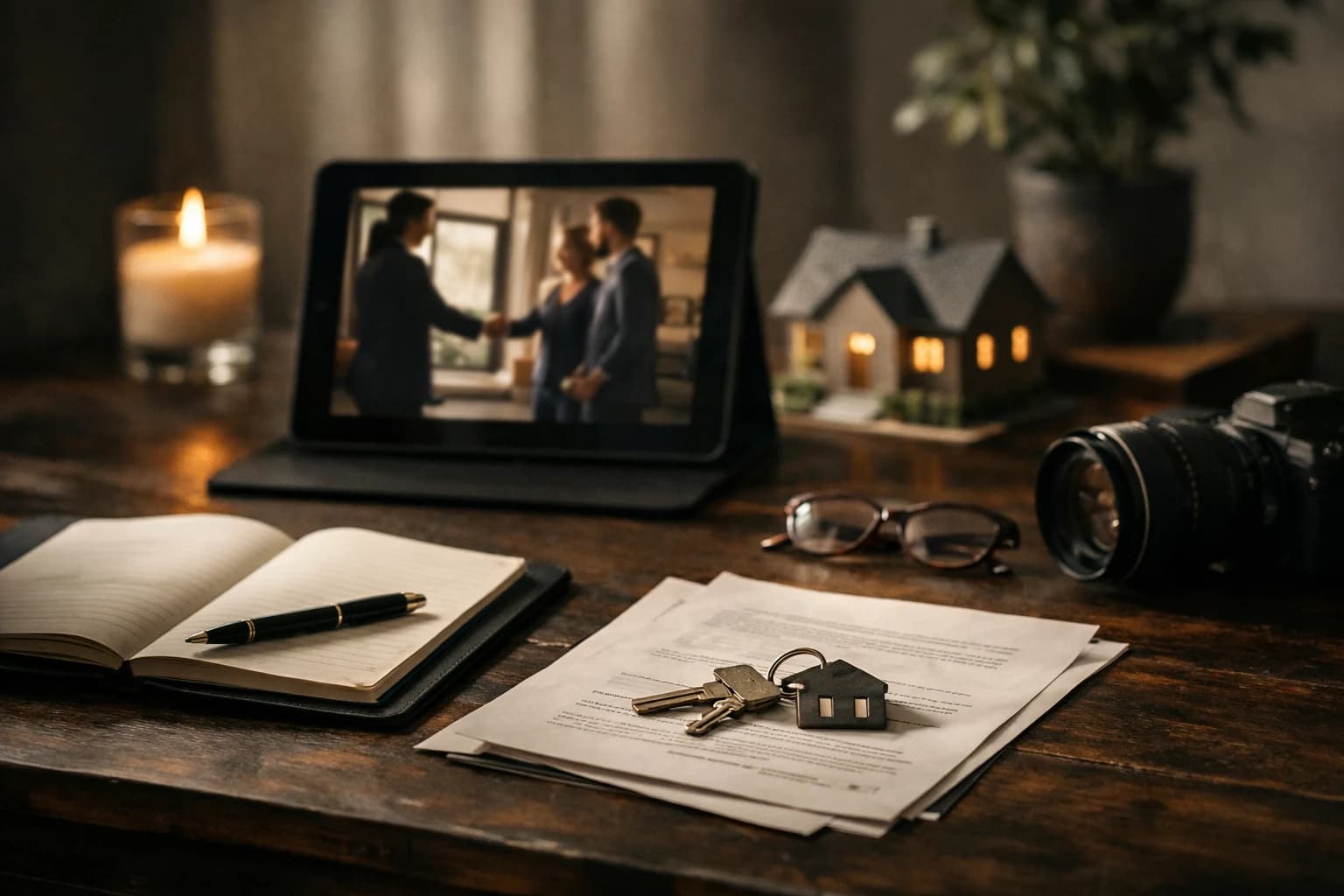
• Tools-of-trade details (handshake, keys, contracts, branded clipboard) photographed candidly
• Community moments (talking with a neighbor, supporting a local business)
• Behind-the-scenes stills (with your photographer or prepping a listing)
• One cinematic still for social cover/header use
Prep notes for the agent:
• Bring 2–3 outfit options: one elevated/business, one approachable/casual, one layer or accent that reads on video.
• Bring props that feel real (tablet, coffee mug, map, architectural sample).
• Choose two settings: one that conveys market authority (office or luxury listing) and one that expresses local connection (block, park, shopfront).
On-camera confidence: a short routine that works
Long coaching sessions aren’t necessary. Use this micro-routine before any recording:
1. Reduce cognitive load (30 seconds): take three slow breaths, smile for five seconds, and ground your voice by speaking a single declarative sentence out loud—something like, “I help families move with less stress.”
2. Use an artifact to focus (holding an object): hold a set of keys or your phone—this gives your hands a purpose and reduces fidgeting.
3. Anchor your rhythm (a two-line opener): lead with the hook, then the value. Example: “If you’re looking at homes near [neighborhood], here’s one quick thing to watch for—and how I help.”
4. Keep takes short (30–90 seconds): short, intentional takes reduce the risk of rambling and give you repeatable soundbites to repurpose.
Scripts that scale without sounding scripted
Use short skeletons instead of word-for-word scripts. Record multiple takes with the same skeleton to capture different tones.
• Origin hook (30s): What drew you to real estate + one value
• “I got into real estate because I like helping people make big life moves. The thing I care about most is making complicated decisions feel clear.”
• Problem–solve clip (45–60s): problem, your approach, what clients experience
• “One common challenge I see is X. What I do differently is Y, which means my clients usually avoid Z.”
• Local tip (15–30s): quick neighborhood insight
• “If you’re moving here, the best weekday for open houses is…”
Repurposing without reinventing: the 1-to-7 storytelling multiplier
Record one 60–90 second story and you can create at least seven useable pieces:
1. The full 60–90s clip: LinkedIn or Facebook post
2. Two 15–30s social teasers: Instagram Stories, Reels, TikTok
3. One 30s captioned video for Instagram feed
4. A still hero portrait with a 100–150 word caption drawing on the clip
5. A 3-photo carousel showing the micro-process with a micro-takeaway
6. An email blurb linking to the full clip and a client resource
7. A blog post that expands the lesson and embeds the video
The goal is not volume; it’s consistent, story-driven signals that reinforce the same brand message across channels.
Using listing media to reinforce your brand (without overstepping)
Listings are a repeating opportunity to send brand signals. Two practical ways to use listing media:
• Include a branded agent portrait in the listing gallery (one tasteful image near the contact info). It humanizes the listing and makes your profile consistent across platforms.
• Lead videos with a 5–10 second branded opener (your portrait or logo and a simple tagline) so viewers experience continuity from property to agent.
Be candid about tradeoffs: too many agent images on every slide can look self-promotional. Use them strategically—front and back of a listing gallery, and in your listing landing page header.
Building local recognition and community authority
Consistency is a credibility multiplier, but it must be paired with locality. These tactics are practical and repeatable:
• Pick 3 neighborhood anchors to feature regularly (a park, a school, a cafe). Rotate short profiles or micro-guides.
• Use community events as storytelling opportunities—capture 1–2 short clips and 3–5 photos to distribute across channels.
• Partner with one local business for a co-created piece (e.g., “Why this café is perfect for open-house coffee”) and cross-promote the content.
Creating trust through consistency and social proof
Trust grows from repeated, reliable signals. Focus on cadence more than scope:
• Publish one short story every week and one deeper piece every month. Consistency matters more than frequency.
• Use client voices as story evidence without over-relying on quotes. Short client soundbites (15s) that describe the emotional result—confidence, relief, clarity—are stronger than generic praise.
• Keep public metrics discreet. Don’t make follower counts a centerpiece of your message; instead feature the client outcome or community impact.
Practical 6-week action plan (one-person agent)
1. Week 1: Brand Story Filter + pick 3 signature story types. Brief photographer and book a half-day branding session.
2. Week 2: Attend branding shoot. Record three 60–90s stories on camera. Gather 40–60 images.
3. Week 3: Select and edit 6 hero images and 3 short clips. Draft a 4‑week content calendar.
4. Week 4: Publish first story (video + portrait + email). Promote at least once across two platforms.
5. Week 5: Publish second story and a neighborhood narrative. Record b-roll during a local visit.
6. Week 6: Review engagement, note two recurring audience questions, create two short clips answering them for next month.
Branding checklist (session & content-ready)
• Pre-shoot: identify three stories, prepare 2–3 outfit options, choose two locations.
• During shoot: capture hero portraits, process shots, neighborhood visuals, and behind‑the‑scenes.
• Post-shoot: select 6 hero shots, 3 short video clips, and transcribe video audio for captions.
• Distribution: schedule one weekly story, repurpose according to the 1-to-7 multiplier, and include a branded image in every new listing.
Image direction (recommended Helios portfolio asset)
Recommended: an authentic agent portrait from a Helios branding session—preferably a relaxed environmental portrait of an agent in their local neighborhood or working on-site with a client. Also consider a behind‑the‑scenes still of an agent directing a shoot or reviewing listing photos to illustrate process and authority.
Closing guidance
Authentic storytelling isn’t a marketing trick; it’s a discipline. Your daily interactions—how you explain a process, how you show up in a community, the images you choose—are the raw material. Treat storytelling as a measurable habit: pick three signature stories, capture durable visual assets, and publish with consistency. Over time those signals build recognition, trust, and referrals.
If you want help turning this into a concrete visual plan, explore Helios Agent Branding and Content Creation services, view relevant portfolio examples, or schedule a consultation to develop photo and video content that fits your market and your voice.