
Overview
Posting more often won’t fix a weak positioning. But a disciplined, brand-forward content process will. Consistency gives your audience a predictable signal: who you are, where you work, and what you do for clients. That predictability converts into local recognition—and recognition is the first step toward trust.
This playbook is practical: templates, shot lists, short video scripts, and a repurposing map you can run every week. It assumes you already have a professional agent portrait and a small library of listing media (photos, a hero video, and filmed B‑roll). If you don’t, treat the first two days of execution as a branding shoot and plan for the session described below.
Core strategy: three things to lock in before you create anything
1. Clear positioning statement (one sentence)
• Who you help (neighborhood, buyer type, seller type).
• What you do differently (process, niche expertise, service design).
• The outcome you deliver (clarify it in practical terms: speed, simplicity, certainty—avoid unattainable promises).
Example (structure only): “I help [neighborhood] sellers get a clear, staged presentation and a predictable plan to sell in 30 days.” Keep it short; you’ll use this in captions, intros, and scripts.
2. Visual anchor
• Your primary agent portrait (headshot + 2 candid variations). Use these consistently across listing posts and profile images so audiences connect the face to your content.
3. Three content pillars (rotate weekly)
• Market insight: Local inventory notes, street-by-street nuance, simple myth-busting about selling/buying.
• Local authority: Small business spotlights, neighborhood updates, community calendar highlights.
• Transaction craft: Behind-the-scenes of staging, negotiation tips, explaining a part of your process.
A simple weekly cadence
You don’t need daily posts to stay visible. A consistent, repeatable schedule is easier to maintain—and it looks professional.
Suggested baseline (sustainable and scalable)
• 3 feed posts per week (one per pillar). Use your primary portrait once weekly.
• 2 Stories or Clips per week (short, candid updates; can be repurposed from feed clips).
• 1 long-form post or article every two weeks (LinkedIn, Facebook Notes, or Instagram Caption > 500 words).
Batching and production: how to spend 3 hours to produce 3 weeks of content
Pre-shoot checklist (30 minutes)
• Confirm your one-sentence positioning.
• Select 1 primary portrait, 2 candid portraits, and 4 listing stills to be used as backgrounds.
• Prepare three 20–40 second scripts (below).
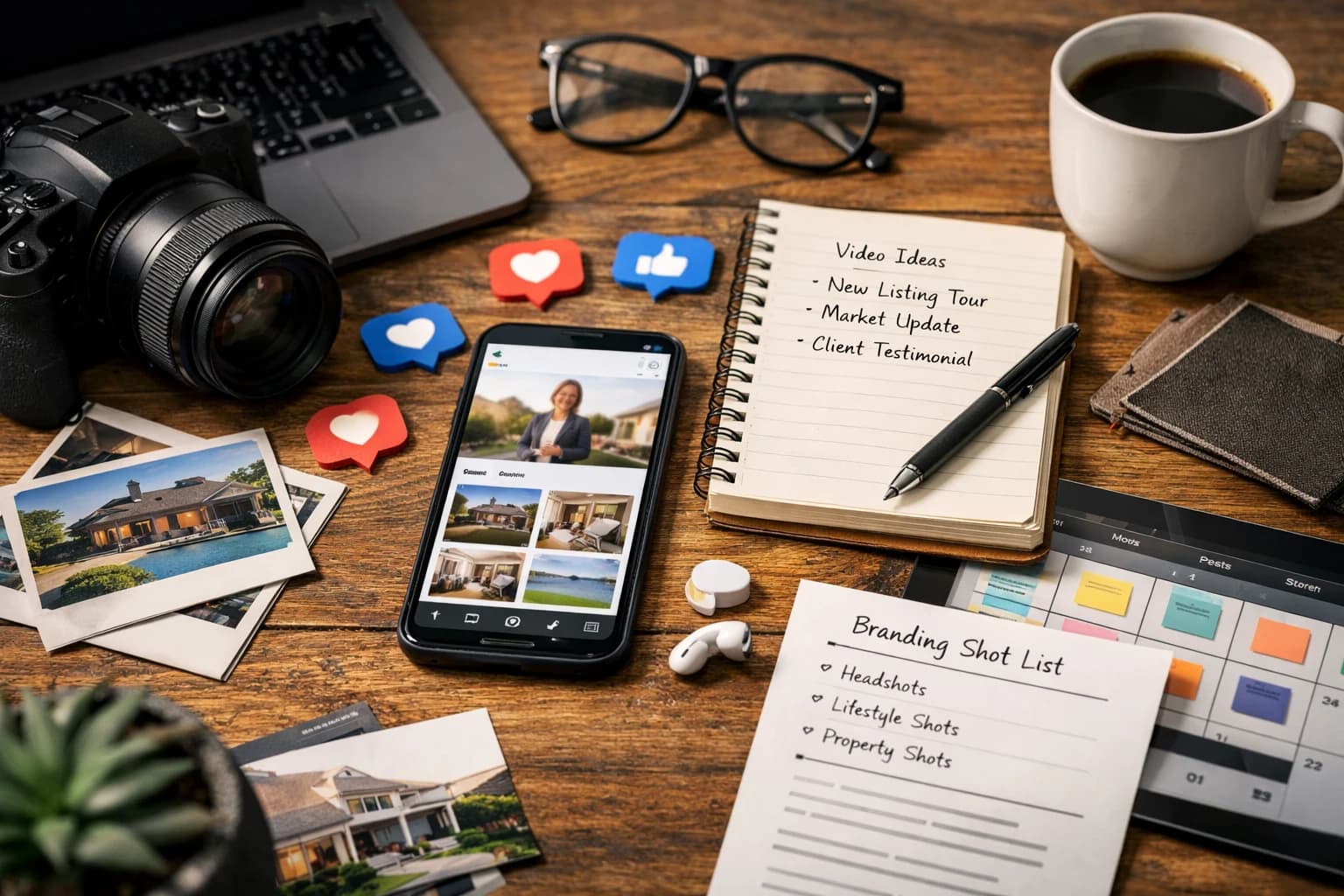
Branding session shot list (60–90 minutes)
• Portraits: headshot (neutral background), environmental portrait (agent at desk or on a neighborhood street), candid smiling while on phone or with a client (actor) — 3–5 frames each.
• Short-form video clips: 3× 30–45 second intro clips (same script said 3 ways), 6–10 seconds of b-roll (walking a street, pointing out features, opening a front door), a 15–30 second “process” clip (staging walk-through, paperwork explanation).
• BTS content: photographer adjusting lighting, agent review screens, coffee-and-notes shot — useful for Stories and authenticity.
On-camera scripts (use these as templates; speak conversationally)
1) 30‑second market micro-update
• Hook (3–5 seconds): “Quick market note for [neighborhood name]—”
• Body (15–20 seconds): One specific observation (inventory up/down, price band movement, or what’s selling fast). Follow with a practical takeaway: “If you’re thinking of selling, this means…”
• Close (5–8 seconds): Call to action: “If you want a quick, no-pressure valuation, DM me and I’ll drop by.”
2) 30‑second listing-to-brand bridge
• Hook: “How this home shows what we do differently—”
• Body: A single tangible detail from the listing (staging move, photography choice, repair we handled) that reflects your process.
• Close: “That’s how we make listings stand out in [neighborhood].”
3) 20–30 second community spotlight
• Hook: “[Local business name] is why I love [neighborhood]—”
• Body: A concise reason (history, specialty, or owner story). Keep it human, not promotional.
• Close: “I feature local partners like this in every home launch.”
Repurposing matrix: turn one shoot into ten assets
Start from: 1 hero reel (30–45s), 3 portrait images, 4 listing stills, 5–8 B‑roll clips.
Create:
• 1 vertical hero reel (rework intro clip + b‑roll + one still) for Instagram/TikTok/YouTube Shorts.
• 2–3 short reels (10–20s) focusing on micro-topics (neighborhood fact, staging tip, quick FAQ).
• 3 carousel posts: portrait + 3 listing photos + a caption that links the image to your positioning.
• 4 Stories: BTS, quick poll, link to new listing, and a short client education clip.
• 1 LinkedIn post that expands the caption into a 300–500 word micro-essay about the listing or the neighborhood.
Caption template: fast structure you can replicate
• Hook (one sentence that stops the scroll).
• Value (2–3 short paragraphs; one practical tip or insight).
• Local tie (1 sentence tying to neighborhood or audience).
• CTA (soft): “Curious about X? DM me or tap the link in bio to schedule a quick call.”
How to use listing media to reinforce your brand
• Lead with you: In social posts that showcase listings, include one image that features you in the property (candid environmental portrait). That ties the sale to the agent, not just the home.
• Consistent color grade and typography: use the same tone on your social thumbnails and email headers to build recognition. Don’t let every listing look like a different brand.
• Reframe listings as lessons: instead of only selling the home, use a carousel to explain one thoughtful decision you made on that listing (pricing, repairs, staging). This shows craft and educates your audience without being salesy.
Building local recognition and community authority
• Sponsor small moments, not big buys: host a micro-event (coffee with a local lender), do a short street guide video, or spotlight a local service provider. Document it and use the footage across platforms.
• Use the same opening line across channels: a short verbal signature—e.g., “This is [Name] in [Neighborhood]—” —helps people recognize you within seconds.
• Publish a periodic ‘neighborhood pulse’ post (same format each month). Familiarity breeds recall.
Create trust with consistency and social proof—without testimonials
• Process posts: show steps you take on every listing. People trust repeatable, transparent workflows.
• Visual before/after (staging, declutter): images that show tangible effort are persuasive without needing quotes.
• Social proof via public data: if a listing changed status (e.g., price or going pending), post an update that explains what happened and why. Keep it factual and educational.
Practical 60‑day action plan (one executive day, then weekly maintenance)
• Day 1 (4 hours): Branding shoot + batch 3 scripts + capture 15 B‑roll clips.
• Week 1–4: Post 3 feed posts/week using the cadence above. Reserve one post each week for a portrait-based brand message.
• Week 5–8: Evaluate what’s easy to produce and what your audience responds to. Continue batching one afternoon every four weeks to refill the content library.
What to measure (qualitative + simple quantitative)
• Message volume: are you receiving more direct messages or inquiries? Track lead source when a call comes in.
• Content peel: which posts get conversation? Prioritize the topics that generate meaningful questions.
• Local recognition cues: are you being mentioned by local businesses, or invited to community events? Track these as evidence of rising local authority.
Common tradeoffs and how to manage them
• Quantity vs. craft: lower frequency with sharper positioning beats a scattershot daily feed. If you must choose, prioritize clarity and a consistent look.
• DIY vs. professional media: smartphone clips are fine for behind-the-scenes. Use a professional branding session for hero portraits and signature reels that anchor your brand.
• Authenticity vs. polish: aim for honest, well-produced content. Too much polish can feel detached; too little can undermine credibility.
A short checklist to start this week
• Write your one-sentence positioning and pin it where you write captions.
• Book a 60–90 minute branding session. Bring three outfit looks and two neighborhood backdrops.
• Script three 30‑second clips using the templates above.
• Schedule a single 3‑hour block to batch and publish three weeks of content.
Conclusion
Consistency is the practical lever that turns good creative work into recognizable local authority. Lock in your positioning, invest in a clear visual anchor, and choose a sustainable cadence you can maintain. Over time, predictable, well-branded content creates familiarity—and familiarity leads to trust.
Next step
If you want a predictable, brand-forward set of photos and short films to run this playbook from day one, explore Helios Agent Branding and Content Creation services or schedule a consultation to outline a shoot and content plan tailored to your market. View Helios portfolio examples for agent portraits, on-location branding sessions, and cinematic short reels that illustrate the exact formats described here.
Suggested image
An on-location agent branding portrait from a Helios branding session—environmental portrait with cinematic light, agent engaging with a client or the neighborhood (use as hero image on social and blog posts).